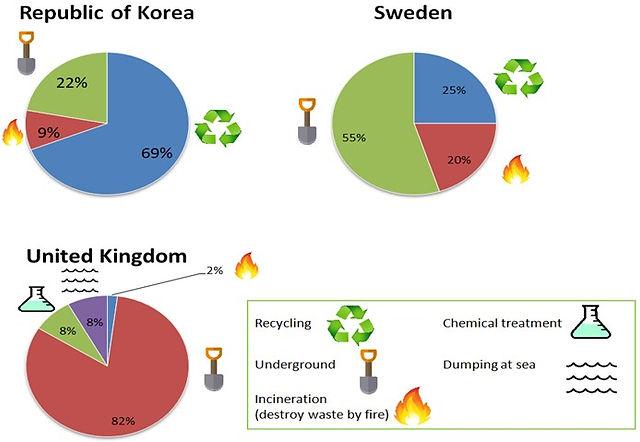
The pie chart below show how dangerous waste products are dealt with in three countries.

✍️ Want to check your own essay?Try for free →
The pie chart below show how dangerous waste products are dealt with in three countries.
IELTS Writing Task Chart for The pie chart below show how dangerous waste products are dealt with in three countries.
These graphs illustrate the different treatments of hazardous waste products in three countries
Overall
Linking Words
, we can see that one of the most commonly used ways to get rid of hazardous trash is by burying it underground. The first two countries, Sweden and South Korea, have similar methods to deal with these products, with only the proportion of said forms changing. Swedish recycle a quarter of its debris,
together with
Linking Words
burning, which takes about 20% of the whole . The rest is being stored underground. The Asian country,
on the other hand
Linking Words
, recycles a good majority of their toxic garbage , filling up 69% of its diagram. Burning represents roughly a tenth of the pies ,
while
Linking Words
the underground storying makes 22%. The
last
Linking Words
country, being the United Kingdom, possesses vastly different practices.
Firstly
Linking Words
, subterranean storage is their main way of dealing with
such
Linking Words
products; it takes 82% of the total, more than any other method in any chart.
Secondly
Linking Words
, the United Kingdom uses two new technologies: sea dumping and chemical treatment, both representing 8%.
Lastly
Linking Words
, burning the garbage is only used in 2% of the country’s toxic rubbish treatment.

Unauthorized use and/or duplication of this material without express and written permission from this site's author and/or owner is strictly prohibited. Excerpts and links may be used, provided that full and clear credit is given to Writing9 with appropriate and specific direction to the original content.

Conclusion: The conclusion is too long.
Vocabulary: Rephrase the word "undefined" in your introduction.
Vocabulary: Use several vocabularies to present the data in the second paragraph.
Topic Vocabulary:
  • dangerous waste
  • recycling
  • incineration
  • waste management
  • percentage
  • burial
  • environmental impact
  • strategy
  • comparison
  • significant
  • methodology
  • effective
  • implications
  • trend analysis
What to do next:
Look at other essays: