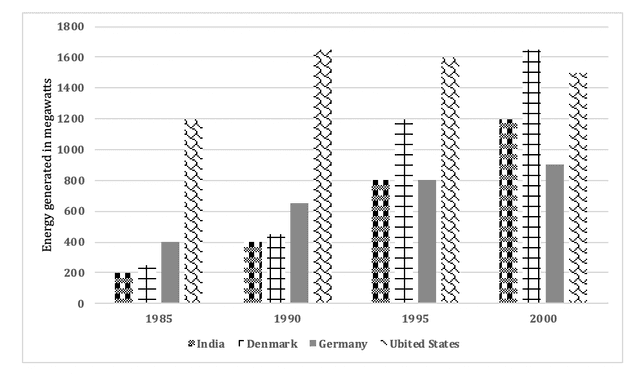
The bar chart shows the amount of energy generated by wind in four countries from 1985 to 2000.

7.5 / 9
✍️ Want to check your own essay?Write on this topic →
The bar chart shows the amount of energy generated by wind in four countries from 1985 to 2000.
IELTS Writing Task Chart for The bar chart shows the amount of energy generated by wind in four countries from 1985 to 2000.
The graph depicts the quantity of energy generated by wind in four different countries, during a period of 15 years,ending in 2000.
Overall
Linking Words
,
it is clear that
Linking Words
globally, the United States is much more powerful than India, Denmark andGermany too. So, it is true that all countries are globally increasing every five years.
For instance
Linking Words
, India increased from 200Mw in 2,985, to 1,200 megawatts in 2000, so 5 times more.
Then
Linking Words
, Denmark
also
Linking Words
presents a large growth from approximately 250 megawatts in the first year, until 1,600Mw in the
last
Linking Words
year , which represents a significant evolution. Germany began with a number of 400 and grew to almost 1,000.
Finally
Linking Words
, the United States started with a higher number than the others, with 1,200, growing until 1,600 in 1990 and
then
Linking Words
decreasing slowly until 1,500 megawatts in 2000. It is the only region that decreases
at the end
Linking Words
compared to the others.

Unauthorized use and/or duplication of this material without express and written permission from this site's author and/or owner is strictly prohibited. Excerpts and links may be used, provided that full and clear credit is given to Writing9 with appropriate and specific direction to the original content.

Sentences: Add more complex sentences.
▼
Conclusion: The conclusion is too long.
Vocabulary: Use several vocabularies to present the data in the second paragraph.
▼
Topic Vocabulary:
  • wind energy generation
  • megawatts (MW)
  • renewable energy
  • energy production
  • growth trend
  • decline
  • technological advancements
  • government policies
  • historical data
  • relative contribution
  • energy mix
  • comparison
  • renewable resources
  • sustainability
  • capacity
  • installations
  • annual production
  • percent increase/decrease
  • between 1985 and 2000
  • notable changes
  • country-specific trends
What to do next:
Look at other essays: