
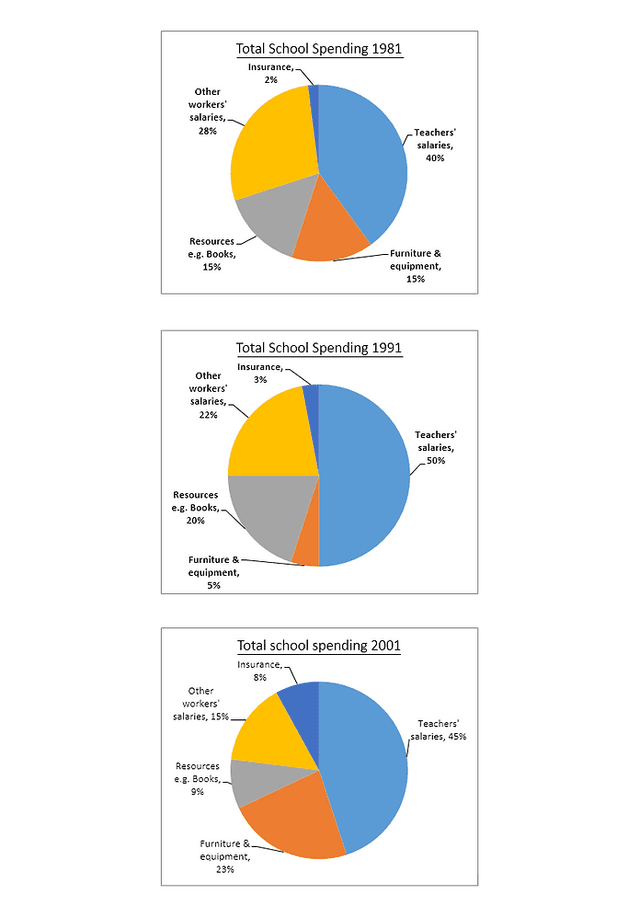
The pie charts
illustrates
a breakdown of annual spending by a particular UK school over a period of 20years from 1981 to 2001.
Correct subject-verb agreement
illustrate
Overall
, teachers' Linking Words
salaries
accounted for the largest share of school spending throughout most of the period, Use synonyms
while
the lowest spending was observed in insurance. Meanwhile, there was a steady drop in spending Linking Words
of
other workers' Change preposition
on
salaries
over the decades.
The percentage of teachers' Use synonyms
salaries
rose gradually from 40% to 50% between 1981 Use synonyms
to
1991, reporting the highest figure, and declined to the 45% in the end of Correct word choice
and
2001
Punctuation problem
2001,
while
it was still the most substantial spending.Linking Words
By comparison
, the insurance was the lowest at less than 10% during these years.Linking Words
However
, it experienced a steady increase throughout the period.
The spending of resources Linking Words
such
as books reached a peak of 20% before declining steadily.
Linking Words
By contrast
, the cost of furniture and equipment showed an opposite fluctuation Linking Words
which
was Punctuation problem
, which
same
Correct article usage
the same
to
the teachers' Change preposition
as
salaries
.Use synonyms